Final Fantasy III has a manga.
On its own, this doesn't sound too surprising. Final Fantasy has had a vertiable horde of adaptations after all, such as novels or mangas. Even Final Fantasy I got a manga (a rather interesting one) and Final Fantasy II has a novelization that is the source of The Emperor's true name (which itself gets nods in the games, if never used directly). So, what makes III different?
III... is weird.
(The manga is currently getting a fan-translation via Mangadex. This page shall become refined over the coming weeks/months as I can now actually understand it.)
The manga features most of the guests from the game: The lone guest to be missing is Aria, and even then, she has a spiritual successor of sorts. But we'll get to that.
The manga was the first media to give the main characters set identities. While very distinct from the remake's cast, there are some similarities that blur the possibility of homage vs coincidence.
As the manga was written by the scenario writer, Keji Terada, these characters are technically the closest to "canon" identities of the Famicom party. However, the manga has significant differences to the game and unlike the FF2 novelization (which contributed the "Mateus" name), the III manga has never officially been acknowledged by SE to my knowledge.
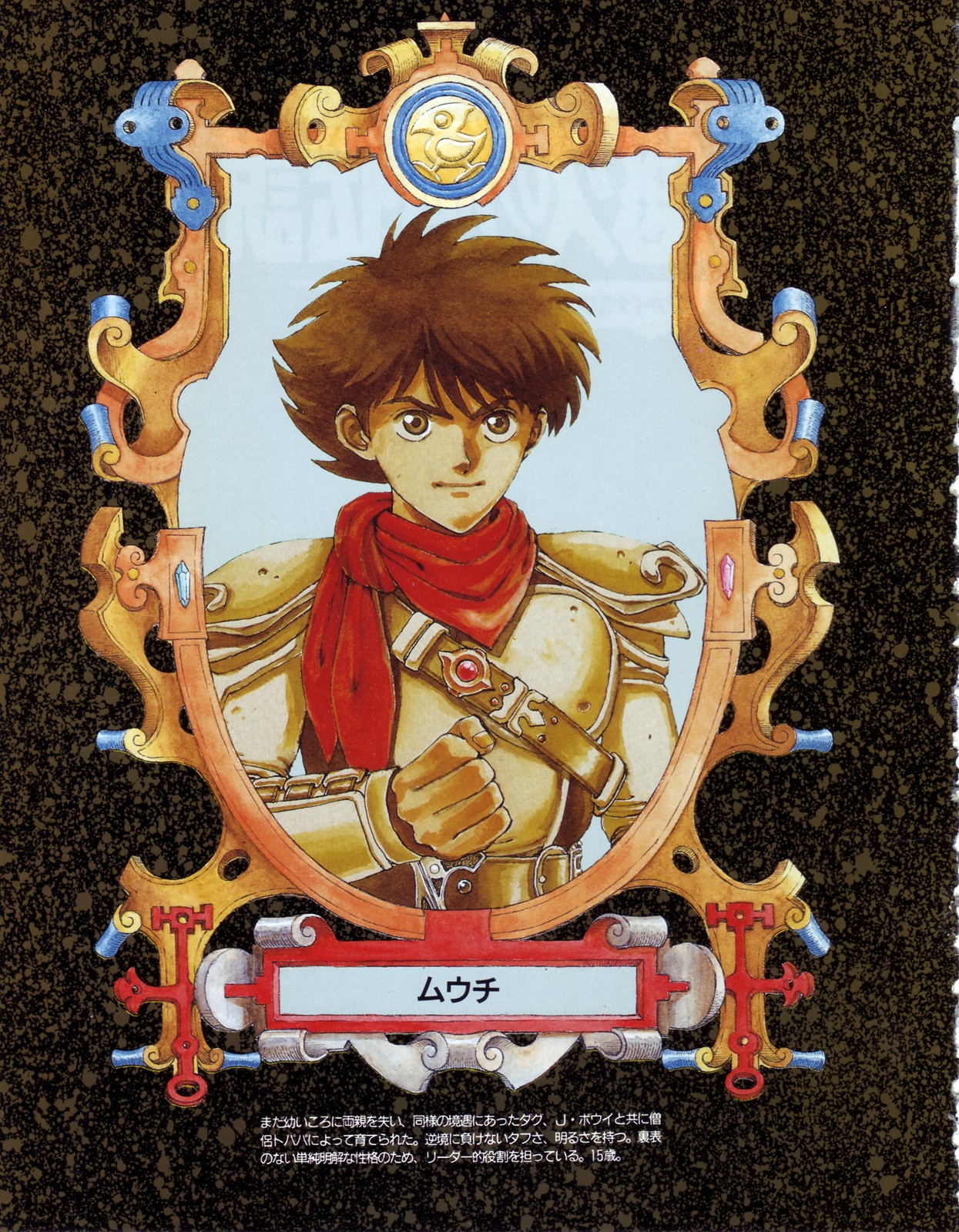
Muuchi is one of the three youths of Ur, alongside his adopted brothers Doug and J Bowie. All three of them are mischevious, stealing from merchants and overall being smart-mouthed brats. Over the course of the manga, however, he grows into a capable hero in his own right. Muuchi usually leads the group, with a notable exception. Muuchi favors swords in battle, using dual blades in the early chapters and a single sword in later chapters. That said, he certainly isn't afraid to use his fists if need be.
DNear the end of the first volume, Muuchi is captured by Desch and promptly brainwashed. He spends roughly half of the second volume like this. To make up for it, he fights against Ifrit, and Hein alone for the remaining half of the second and the first third of the third volume. Muuchi ends up being sent to the demon realm twice (once by Hein, once by Doga and Unei) and seems to become a summoner for it.
His design seems to take cues from the Warrior job. All of the main characters go through outfit changes throughout the manga, but Muuchi favors armors. Muuchi's hair color differs between black, brown and blue-ish.
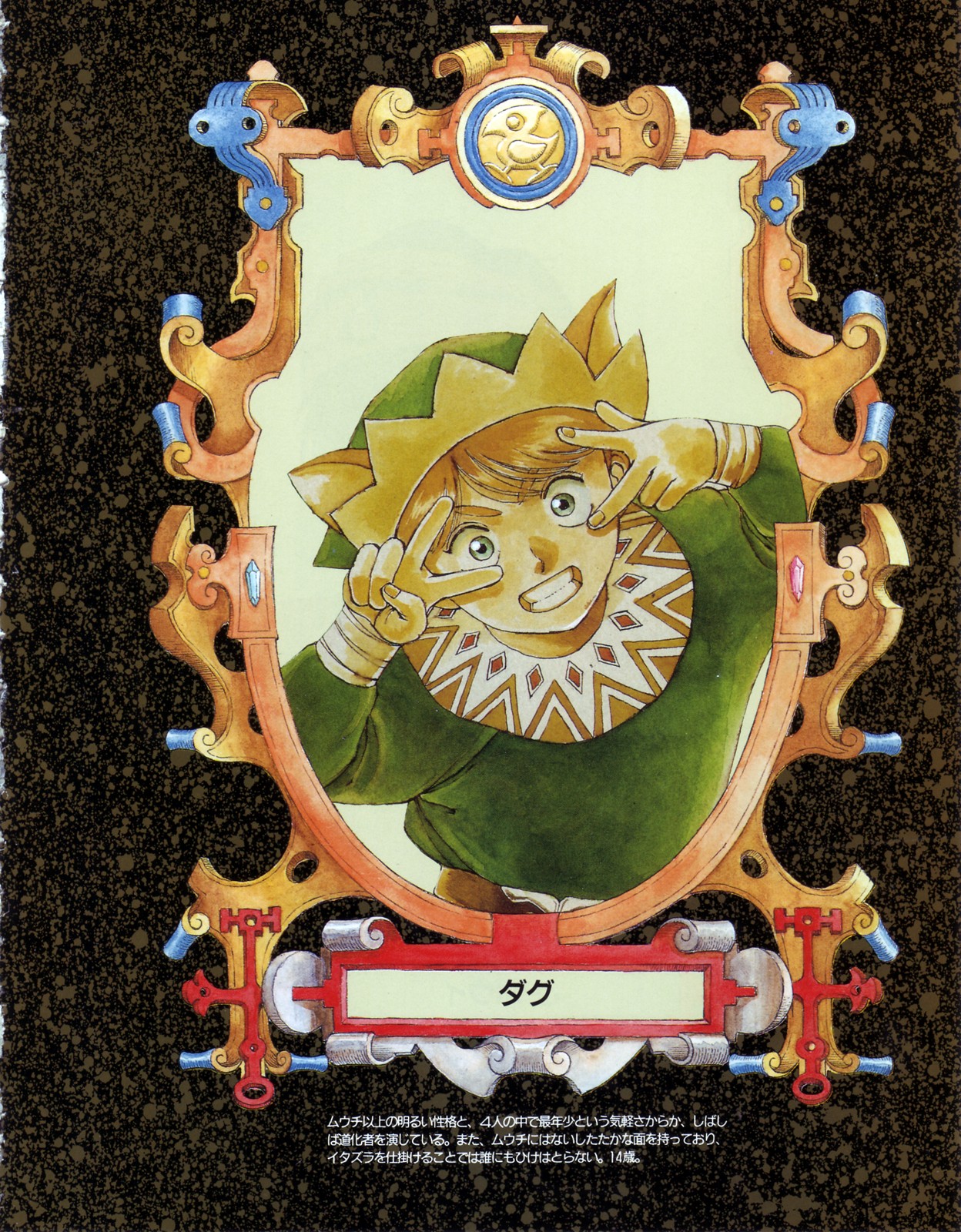
Doug is the second of the three youths of Ur. He's a little guy who usually (but not always) keeps an optimistic air, and ends up being comic relief most of the time, though that's not say that Doug doesn't get placed in serious or emotional situations. Unlike the other heroes, he doesn't use magic; Instead prefering knives and a sort of bendable flail for much of the Desch arc.
Doug's design is vaguely remeniscent of the ranger job, albeit with a headband rather than a hat. Much like Muuchi, his outfit changes as the story goes on. His color scheme also varies the most heavily of the group: He's usually blond with a yellow and green clothes scheme, but one cover protrays him as silver-haired with a silver and yellow color scheme.
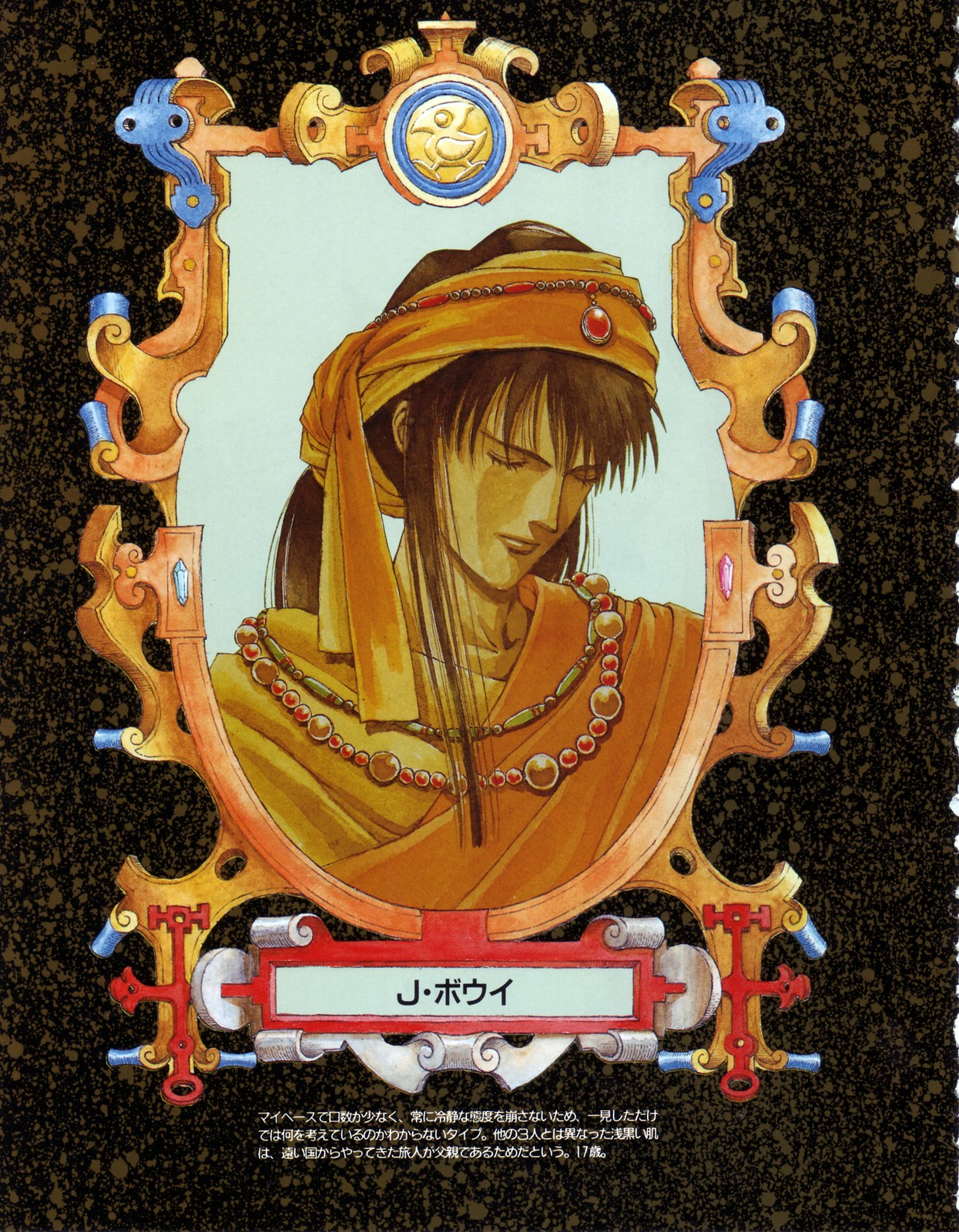
The third of the three youths of Ur. Of the four, he's the oldest at 17 and has a more stoic and calm demeanor. Despite this, he is actually just as prone to causing mischief as his brothers at the start of the manga. He has a particular fondness for girls, such as being immediately set on going to Castle Sasune when Cid mentions that Sara is a looker or being fixated on the dancers (or lackthereof) of the bar Cid takes the group to for dinner. As one would expect, he has a thing for Melfi, which she shows 0 sign of reciprocating.
According to Bowie's description in the first volume, he has darker skin as his father (prior to being orphaned) was a traveler from a faraway land.
During the first half of the manga, he uses twin knives (and some sort of wire aparatus?) as his main weapon. After the party's encounter with the Djinn, Bowie ends up gaining prowess over Black Magic, which uses offensively and as a utility. He also tends to wield a staff in battle
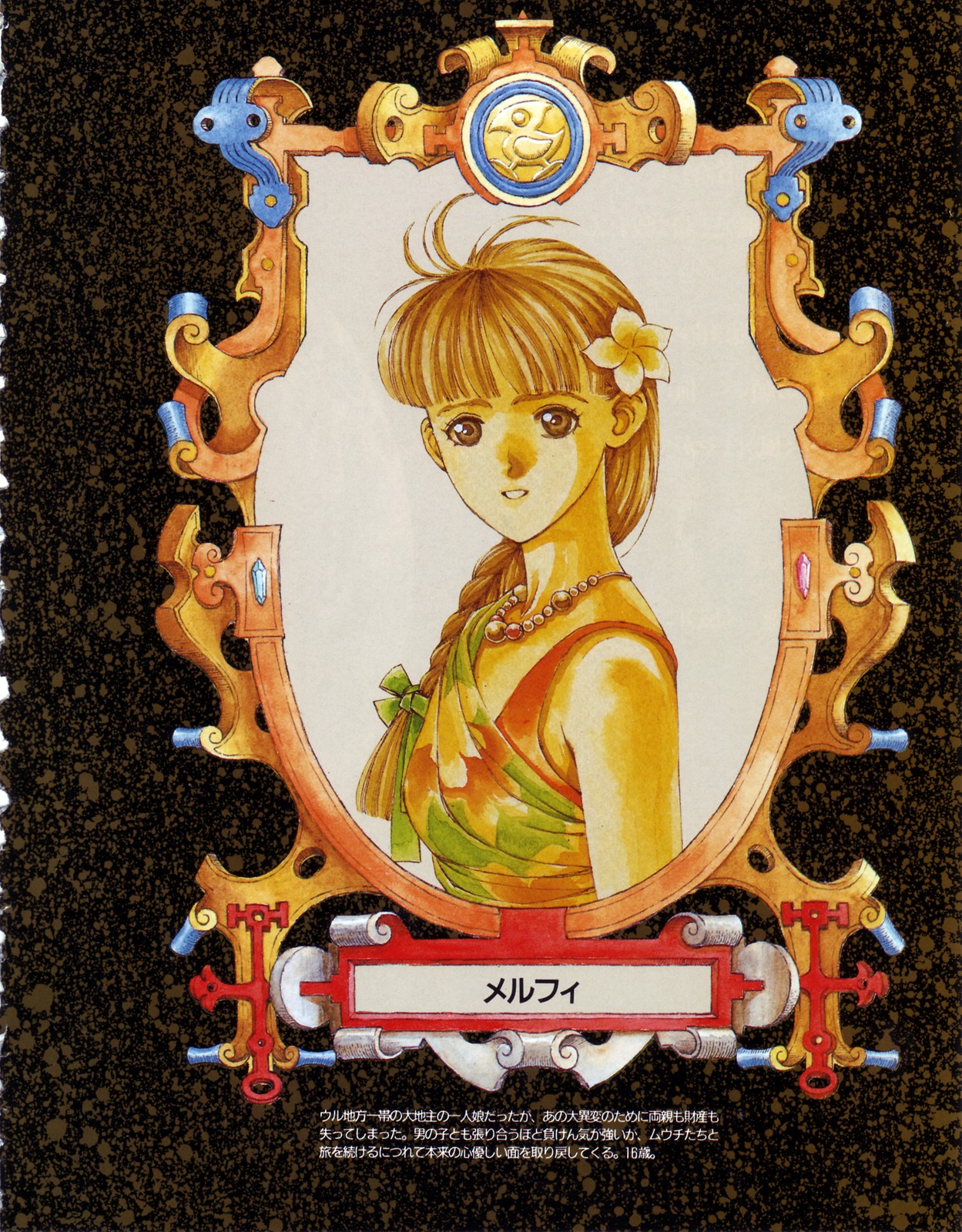
The last of the four Warriors of the Wind and the only one not native to Ur, Melfi is from the next town over, whose parents were killed in the Great Earthquake. She meets the boys at the Wind Shrine, helping them defeat the Land Turtle and while she is initially unimpressed and annoyed by their antics - including an incident where they use her to distract some merchants that they rob, she grows to respect all of them over the course of their journey, especially Muuchi, whom she comes to fall in love with.
She also gets some metaphysical spirit realm thing that usually entails her as a naked spirit or ghost or something?
Melfi primarily uses a bow and arrows as her weapon. When she has latant White Magic prowess due to her family being descended from them, although it's not until the fight with the Djinn that she begins to unlock it. She uses that both for healing and offense. She also uses a sword in spirit form to put the Elder Tree out of its misery.
Cid: Cid appears in the first volume of the manga as one of the spirits the party fights in the ghost town. He is eventually restored due to an old woman sacrificing herself to give him a mythril necklace, breaking the Djinn's power over him. He tells the heroes of what went down at Castle Sasune and accompanies them there. Later, Cid uses his airship to help the heroes travel around the continent in the first half of the story. In this version, the pack on Cid's back functions as a helicopter pack, allowing him (or anyone who uses it) to fly.
In this story, Cid's a rather goofy figure, being initially concerned about his airship than Princess Sara, crashing his airpack into one of Sasune's towers and going off to get drunk when the gang stops at a town. He's not all goofs however, and he gives advice or direction to the Warriors early on.
Sara: The Princess of Sasune, she appears in the second half of the first volume. In this iteration of the story, she is a descendant of the Ancients and thus is knowledgeable about White Magic. Compared to the games, Sara's not quite as capable here; She's initially held captive in the castle by the (giant and far more manacing) Djinn. While she escapes thanks to Cid, she doesn't get to contribute directly to the battle as a (seemingly) possessed J Bowie grabs her right as she picks up Muuchi's sword and sets off to confront the Djinn. Her necklace does play a key role in sealing him, however as it turns out to be made of Mythril.
Djinn: The Djinn is the first major antagonist that the party fights in the manga. His powers are greatly overhauled here: Rather than cartoonish silhouettes, his curse turns people into abstract nightmarish monsters. Combined with his powerful Black Magic prowess, he conquers Castle Sasune and threatens the nearby territories into giving him tribute. He also holds Princess Sara hostage, although he doesn't transform her - it turns out that this is due to her having a Mythril necklace, the metal being his greatest weakness.
The Djinn works with Black Magic, which is destructive and powerful, allowing him to creat cyclones and even pluck a nosehair and turn it into a swarm of monsters. In particular, he traps Muuchi's friends in barriers, traps Muuchi himself in the ground and turns J Bowie's nervous system and cells against each other, causing his body to tear itself apart before threatening to shatter him.
Personalitywise, the Djinn is arrogant with delusions of grandeur. He call Sasune his castle and constantly boasts about his power. Naturally, he gets angrier and angrier as Muuchi refuses to surrender and constantly backtalks him. In the end, J Bowie realizes why he acts like this: The Djinn was sealed away in a mythril mine by high-ranking mages who had enough of his antics and he's considered an outcast amongst even low-level mages. Meaning he is effectively a nobody making a name for himself by tormenting people weaker than him.
Interestingly, as Bowie seals him back, he vows that the Warriors of the Wind will soon face Xande's wrath. While the Djinn was released by the Great Earthquake in the game, there is little indication that he's directly in league with Xande, his release being more of a side-effect.
Desch: One of the more extensively altered characters, Desch appears towards the end of the first volume, atop the back of a massive bird and looking far more sinister. Desch functionally serves as the main antagonist for a significant chunk of the manga: abducting people and brainwashing them into following him: One of those people in question being Muuchi. However, Desch turns out to be under the influence of the Elder Tree, whose sorrow turned into a corruptive force, which caused the birds to start brainwashing people: Once Melfi puts it down, everyone brainwashed by the tree is released from its influence, including Muuchi and Desch.
Desch tells the party of Hein and joins them in infiltrating the Ancients' Castle and fighting the mage. After Hein is defeated, Desch suddenly remembers that he is one of the descendants of the Ancients - even reciting a verse passed down through his family - and sacrifices himself to the Mother Tree, in the process opening the way for the Warriors of the Wind to reach the motherland (aka, the Surface World). Desch notes that his duty was always to meet the party.
While Desch's artwork has him carrying a sword, with the remake realigning him as a Red Mage-like character associated with Lightning, The manga portrays him as a monk-like character, having great strength and fighting with his fists. In this adaptation, Desch is a birdtamer - As Bowie points out, he has scars on his arm due to the nature of how birdtamers gain the trust of birds: By offering the birds food on their arms, in a way sacrificing their flesh. This is moreso apparent during his evil phase, but during the fight with Hein, Desch calls one in to attack him.
Hein: Hein (known here as "Baron Hein") appears as the major villain of the second half of chapter 2 and the first half of chapter 3, squatting in a castle that previously used to belong to the Ancients before he wiped them out. In this adaptation, in lieu of the barrier shift, he is a summoner who has power over Shiva and Ifrit due to a magic ring. He mostly uses them to fight, with Shiva freezing the party and Ifrit fighting Muuchi.
However, as the fight with Muuchi goes on, The summoned demons begin to go against Hein's wishes - Shiva refuses to shatter Muuchi's friends when trapped in ice and Ifrit eventually paints a cross in his own blood, the cross being a sign of armistance (i.e. he doesn't want to fight anymore). Hein promtply loses it and attempts to execute Ifrit, but Muuchi slugs him in the face.Annoyed, Hein fuses with Ifrit and Shiva into a monster. He manages to get the upper hand over Muuchi both physically (stabbing and almost killing him; Muuchi thinks about his friends, which emboldens him) and mentally (he allegedly sends Muuchi to the Demon World, creating illusions of a clone Muuchi's head melting and a grotesque worm creature emerging from Muuchi's gut to eat him). However, Ifrit and Shiva revolt against Hein, both helping Muuchi recover from his mental attack and by attacking him, allowing Muuchi to use the Ancients' Sword to defeat him.
Like the Djinn, Hein is explicitly working for Xande in this adaptation.
Alus: The Prince of Solrados, Alus appears mid-way into the third volume, descending from the heavens with a group of men to save the Warriors of Light from Echidna. His overall duty is to guide them to the Water Crystal, where Unei is trapped, pierced in the heart by it. Along the way, he explains the earthquakes that led to the downfall of his kingdom - which Melfi recognizes as a fairy tale her mother always told her. Alus explains that he is a dream-child: A sort of familar whom Unei granted her lifeforce towards after he died and while she was falling under Xande's dreaming curse. As such, Alus outlived his natural death and waited (along with an entourage of poets, whose performance camoflauged them from enemies) and waited for the Warriors of the Wind to arrive. Alus eventually binds his consciousness to the Warriors of the Wind to allow them to raise the Water Crystal and revive Unei. Having fulfullied his role, Alus dies once more and Unei sends his body on.
In a manga full of weird changes, Alus' are probably the weirdest of them all. Alus' role in the manga matches much more closely with that of Aria in the games: Being the first person the party encounters on the surface, aiding the party in resurrecting the crystals and dying at the end of it. Had it not been for the presence of the kingdom (Solrados, rather than Saronia like in the games), one would question why he was used rather than Aria. Another change is his family. In the game, Alus only has a father: He has no mother (though design docs suggest the Saronia Civil War was originally between a king and queen, the remake would eventually have NPC dialogue confirming she's dead) and no siblings. In the manga, Alus does have a mother and one sibling - who are seen as he watches them be taken by the waves.
Manga Alus is not a happy character.
Alus' age also appears to have been bumped up: In the games, Alus is stated to be 10. In the manga, however, he is as tall as the mid-late teenage party.
Doga & Unei: Much as in the game, Doga and Unei make their entrance late into the story, although Doga is revealed to have been active much earlier than that. Throughout the manga, the wind speaks to the Warriors and occasionally aids them outright. As Unei reveals late in the story, that Wind was Doga (something that was similarly stated in the "Legend of the Eternal Wind" album, although he says that he was only fulfilling the will of the Wind Crystal. He's even nicknamed "Wind". Doga is also suggested to be the one who raised the Floating Continent into the sky, as he and Unei had foreseen the chaos that Xande would bring about on the surface and created an space that Xande's evil couldn't reach. It's also implied that some aspects of the heroes' journey (including Alus' story living on as a fairy tale that seemed to be an omen of what would happen in the future) were his doing as well. By the time Doga formally enters the story, he's largely concerned with keeping the barrier holding Xande back active. However, between missing Unei and Xande sealing his magic, he's having a hard time.
Unei, much like her game counterpart, is first seen stuck in a deep sleep - in this case, it's due to Xande using white magic to counter her Wrath of the Dream World spell on top of the Water Crystal's tip piercing her heart. When Alus and the Warriors of the Wind unearth the Water Crystal, she's reawakened and free - not just to move around the world of the waking, but to change back to her younger body.
Yup, Unei's old lady body is only used for a couple of panels.
Unei largely serves as an information dump, explaining a lot of what happened and why. While she initially intends to tell the Warriors of the Wind about Xande, the imminant breaking of his seal forces her to instead put them into a dream fashback to when Noah gave them their respective gifts. Her dream powers in general result in her being nicknamed "Dreams" in the same way that Doga is nicknamed "Wind".
While the game was content to leave Doga and Unei simply as collegues, the manga makes them into a couple. Unei explains to Melfi something that her master told her: The concept of the Empty Spring, which is the moment that one seeks and loves another. As long as one is human, the risk of falling into the Empty Spring will make you fragile. Doga and Unei fell into the Spring and Xande took advantage of it by seperating them and sealing their magic to make them weaker. However, Doga later acknowledges that while the youths' compassion is a weakness, it can also be a great source of strength.
When Xande breaks his seal, Doga and Unei eventually reunite with each other... And float naked in a space void? They acknowledge that could not fight off the evils of the world with their magic sealed and that they have reached the limit of all they can do. They leave matters into the Warriors' hands and move on.
But just because they're gone doesn't mean they're gone. Xande uses them (or their bodies?) to attack the Warriors of the Wind. On the flipside, Doga and Unei send Muuchi back to the Demon Realm so that he isn't as soft. Muuchi speculates that they foresaw something like this happening and sent him there to harden him.
Xande: Xande is an interesting case. In the game, Xande didn't have that much screentime, with most of his story told via Doga and Unei. He's seen as one of the more sympathetic villains in the series, as most can agree that getting the 'gift' of being made mortal isn't great. The narrative itself doesn't dwell too much on Xande's feelings aside from "he got mad and is now flooding the world with darkness", so a manga adapation that cuts out the Cloud of Darkness feels like a chance to get a bit more on him.
This preamble is to say that Manga Xande is a figurative (and literal) monster deserving of zero sympathy
Xande is the final boss of the manga. Notably, he initially takes on the form of a giant armored monster that unleashes hordes of demons and doesn't say much (aside from damning Irit and Shiva). He then takes on a form based on Amano's artwork of the scrapped Guardian summon, proclaiming himself to be the world. Finally, after the Warriors of the Wind blast him with one final attack, Xande is shown to have survived, but to have taken quite the beating: he's reduced to a torso with one arm, most of his horns are broken and his face turns more grotesque and monsterlike. Granted, he doesn't remain in this form long before the crystals arrive to impale him.
Xande's personality isn't shown in much detail, but what we see and hear implies that he's quite selfish. Unlike the games, it's never specified what Noah left him, or even if he left him anything at all. The flashback implies that Noah knew that Doga and Unei had the intellect and leadership skills to share his power and make the most of it, implying that Xande lacked those things. Either way, Xande promptly turned on the other two disciples, setting the events of the manga in motion. Xande continues to prove how low he is by taking advantage of Doga and Unei's love for each other, as well as using their forms to further attack the Warriors with not even an acknowledgement of his former fellow pupils. Unei even states that Xande no longer cares for any other humans and only seeks to empower himself; as such, Xande himself is no longer human. While most don't mention it, Xande was arguably acting selfish in the game by lashing out at the world over his newfound mortality, but the manga really paints him as such.
And remember: The Final Fantasy III manga has a much darker tone than the games. Most of what is seen of the the Motherland/Surface world is ruins (primarily of Solrados). The spirits in the early sections aren't goofy outline people, but nigh-comprehensible wisps of eyes, mouths, etc. Hein wiped out all of the Ancients. Unlike the games, where a number of incidents were side effects of Xande's messing with the Earth Crystal (which he still does here, by the way), Xande's evil in this adaptation is kept more vague, but generally implied to be more directly his fault.
In a way, it's interesting. Future material such as the 3D remake or Opera Omnia would "soften" Xande, painting his frustration as valid to a degree and implying that there was some chance for redemption had he not been so laser-focused on regaining his immortality or falling into the Cloud of Darkness' influence. The manga, instead, strips away whatever sympathy Xande has in the game and makes him live up to his title of Demon King. And the manga was written by Kenji Terada, who was a screenwriter for the first three games. Some food for thought.
The Ancients: The Ancients are another of Final Fantasy's "ancient advanced civilizations", though they were the second in the line. The games portrayed the Ancients as a group with advanced technologies such as the Invincible, the Ancients' Maze and, in the Famicom original, the Floating Continent. However, they also manipulated Light, believing it to be a force of good that could never backfire. It backfired and the Warriors of the Dark had to bail them out. Since then, they grew humble and turned away from technology, ekeing out a peaceful existence in the Village of the Ancients.
The manga, surprisingly enough, does less with the Ancients than the game does. The Warriors of the Wind are told to seek them out, which leads them to Princess Sara, who sends them in the direction of Marihuri, which is where the Living Woods is located. When the party eventually arrives there, they find many trees akin to the Elder Tree they encountered previously. But whereas the pollen from that tree had various effects (giving birds the ability to brainwash people, making the brainwashed lose their minds and become buff,), the pollen here shows the group a castle - formerly the Ancient's Castle before Hein killed them all and took over. The party then realize that the Living Woods wants them to retake the castle.
Later, as Muuchi is fighting Hein, he is briefly transported elsewhere where a massive woman's face ask him to bring them salvation. Muuchi realizes that he is speaking with an Ancient and is presented the Ancients' Sword, which carries their spirits. Muuchi uses this sword to defeat Hein and his explanation makes the party realize that the living trees are, in fact, the Ancients' spirits unable to rest. The Mother Tree shows the Warriors the Motherland and sends them down there after Desch returns to it.
The surface doesn't involve the Ancients as much as the early volumes did. The Ancient Sword points the heroes in the direction that they need to go. Interestingly, Doga, Unei and Noah are shown in the Ancients' Castle, implying that they too (and presumably Xande) were Ancients.
Noah: For being such a major character in the narrative, Noah's changes are perhaps the most interesting of them all. For being the "Great Sage", the game is actually somewhat vague on the full extent of Noah's abilities - it instead relies on the capabilities of the Sage class - One of the strongest classes as well as what the parts of himself which he gifts to his students: the power of magic for Doga, the dream world for Unei and his own mortality to Xande. Noah was also never seen on-screen: Final Fantasy III lacks flashbacks (aside from one in the remake) and even when the remake added some new scenes, we never see Noah at all.
The manga, on the other hand, says the quiet parts out loud.
Noah is described when Unei puts the Warriors into a dream and shows them her memories. Noah is said to be a reincarnation of the gods of creation and has enough power to destroy the world and restore it to lush greenery just as quickly. As in the game, Noah bequeaths his power to Doga and Unei as he dies - this time giving Doga his Black Magic and Unei his White Magic. However, there is no mention of him giving his mortality - or anything really - to Xande.
Additonally, this is the only iteration of III's story to actually show Noah onscreen. The manga's depicition of Noah is the only time he has been given a design. And what a design it is.